Stairlift Cost for Stairs With a Landing or Turn (U.S.) — 2026
A staircase with a landing or turn almost always rules out a basic straight stairlift. The rail has to bend around the corner, which means either one custom-built curved lift or, in some homes, two separate straight lifts with a short walk in between. This page explains why that choice exists and what each option typically costs.
Quick answer
A single curved stairlift for stairs with a landing or turn typically runs about $10,000-$20,000 installed, versus $2,500-$8,000 for a basic straight lift, because the curved rail is custom-built for your exact staircase (NCOA, 2026; Fixr, 2025).
Planning information in U.S. dollars (USD)—not a quote.
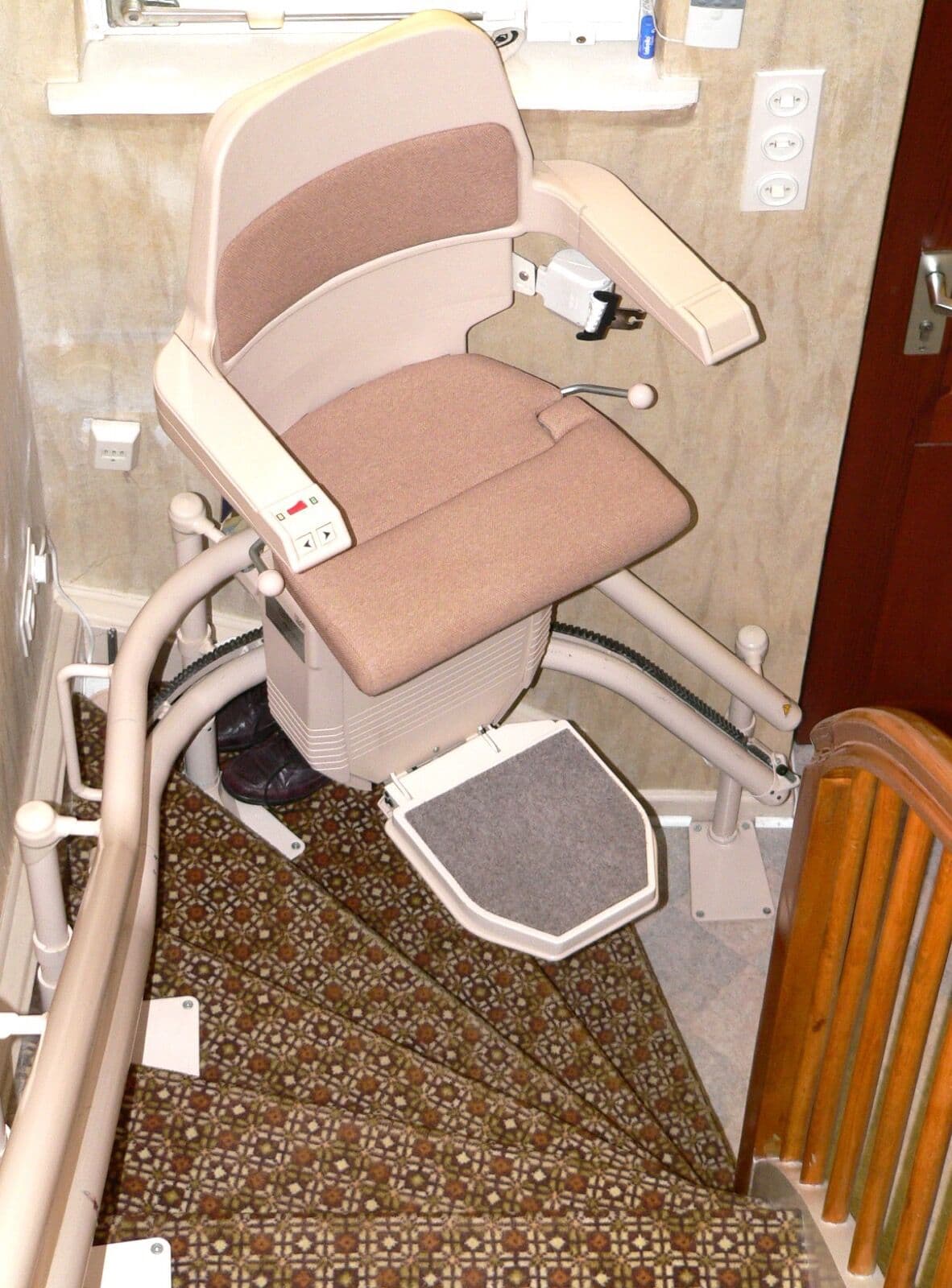
Why a Landing or Turn Means a Custom Curved Rail
A straight stairlift uses a standard, mass-produced rail that can be cut to length in a day or two. The moment your stairs include a landing, a 90-degree turn, a 180-degree switchback, or pie/winder steps, that off-the-shelf rail no longer fits, and you move into curved-rail territory.
According to NCOA, "staircases with landings and turns require custom tracks, extra labor, and can cost significantly more" (NCOA, 2026). A curved rail is measured, engineered, and manufactured for one specific staircase. It usually cannot be reused on a different home and typically takes several weeks to fabricate before installation.
This custom fabrication is the single biggest reason curved lifts cost more than straight ones, not the chair or motor, which are broadly similar between the two.
What a Curved Stairlift Costs Installed
National installed planning ranges (equipment plus installation), anchored to NCOA's cost guide (updated 2026) and Fixr's installation data (updated 2025):
- Curved stairlift: $10,000-$20,000 installed — NCOA's guide lists $8,000-$12,000 ($7,000-$10,000 equipment + $1,000-$2,000 installation), while broader market data runs higher (Fixr, 2025: $8,000-$20,000)
- Straight stairlift: $2,500-$8,000 installed — NCOA lists $2,500-$5,000 ($2,000-$3,500 equipment + $500-$1,500 installation); Fixr: $2,000-$8,000
- Outdoor stairlift: $4,000-$12,000 installed (NCOA, 2026: $4,000-$8,000; Fixr, 2025: $4,000-$12,000)
Within the curved range, the price climbs with the length of the rail and the number of turns. Industry cost aggregators report that added rail complexity can raise the total by roughly $1,000-$5,000 depending on length and the number of bends, and a power-swivel seat (helpful for getting off safely at the top) can add roughly $500-$1,000 (Angi, 2026, listed here as market context, not an independent authority).
These are typical national ranges. Your written quote should be itemized and based on an in-home measurement, not a phone estimate.
One Curved Lift vs. Two Straight Lifts With a Transfer
If your staircase has a flat intermediate landing (rather than a continuous spiral or winder steps), you may have a second option: install two separate straight lifts, one on each straight run, and have the rider stand up, walk a few steps across the landing, and sit down on the second lift. This is sometimes called a "transfer" or "split" setup.
The cost trade-off: two straight lifts can total roughly $5,000-$10,000 combined, often less than a single curved lift at $10,000-$20,000 installed. Two straight rails also install in a day or two, while a custom curved rail typically takes several weeks to manufacture (multiple cost aggregators, listed as market context).
The catch is that the transfer is not right for everyone. The rider must be able to safely stand up, balance, turn, and walk across the landing unassisted between the two lifts, and the landing needs enough room to do so. A single continuous curved lift carries the rider the whole way without ever getting up. This is a mobility and safety decision for the rider and their family, and it should be discussed with the rider's own healthcare provider; it is not a choice to make on price alone.
Ongoing Costs to Budget For (Both Options)
Whichever route you choose, plan for recurring costs after installation:
- Service/maintenance plan: about $100-$300 per year (NCOA, 2026)
- Battery replacement: about $200-$300 every 1-3 years (NCOA, 2026)
Note that a two-lift setup has two units to service and two sets of batteries, which can modestly increase these recurring costs compared with a single curved lift. Ask each company what is covered under warranty versus the paid service plan, and get the plan price in writing before you sign.
Possible Ways to Reduce the Cost
A few avenues may lower your out-of-pocket cost. None is guaranteed, so confirm details before counting on them:
- Medical expense tax deduction. The IRS allows special equipment installed in a home for medical care to be counted as a medical expense, and improvements that accommodate a disability and don't increase the home's value can often be included in full. These are claimed as itemized deductions on Schedule A (Form 1040), and total medical expenses are deductible only to the extent they exceed 7.5% of your adjusted gross income (IRS Publication 502). A tax professional can confirm whether your situation qualifies.
- Reconditioned or rental units are sometimes offered for straight lifts, which can lower the cost of a two-lift setup. Curved rails are custom, so used curved lifts rarely fit another home.
- Medicare generally does not cover stairlifts. Original Medicare does not pay for stairlifts as durable medical equipment; some Medicare Advantage plans or Medicaid waiver programs may offer help, so check directly with your plan (Medicare.gov / Medicaid program rules).
- Veterans may qualify for home-modification grants through the VA; check with VA.gov for current programs.
This is cost and decision-support information only and is not medical or tax advice.
Frequently asked questions
Can I just put a regular straight stairlift on stairs with a turn?
No. A standard straight rail cannot bend around a landing, corner, or winder steps. Stairs with a turn require either a single custom curved rail or, where there is a flat landing and the rider can safely walk across it, two separate straight lifts. NCOA notes that staircases with landings and turns require custom tracks and extra labor (NCOA, 2026).
Is it cheaper to buy two straight stairlifts instead of one curved lift?
Often, yes. Two straight lifts can total roughly $5,000-$10,000 combined, frequently less than a single curved lift at $10,000-$20,000 installed (Fixr, 2025; market aggregators for the two-lift figure). But the rider must be able to safely stand, turn, and walk across the landing between the two lifts, so it is not the right choice for everyone and should be discussed with the rider's healthcare provider.
Does Medicare or my taxes help pay for a curved stairlift?
Original Medicare generally does not cover stairlifts; some Medicare Advantage or Medicaid waiver programs might, so check your plan. For taxes, a medically necessary stairlift can often be counted as a deductible medical expense on Schedule A, subject to the 7.5%-of-AGI threshold (IRS Publication 502). Confirm eligibility with your plan and a tax professional.
Want to estimate your range in under a minute? Try the free stairlift cost calculator.
Sources
- NCOA - How Much Do Stair Lifts Cost? A Complete Guide:
https://www.ncoa.org/article/stair-lift-costs-a-complete-guide/ - IRS Publication 502 (2025), Medical and Dental Expenses:
https://www.irs.gov/publications/p502 - Medicare.gov - Durable Medical Equipment Coverage:
https://www.medicare.gov/coverage/durable-medical-equipment-dme-coverage - VA.gov - Housing Assistance and Home Modification Grants:
https://www.va.gov/housing-assistance/disability-housing-grants/ - Angi - Curved Stair Chair Lift Cost (market context, not independent authority):
https://www.angi.com/articles/curved-stair-chair-lift-cost.htm - Fixr - Stairlift Installation Cost:
https://www.fixr.com/costs/stairlift-installation