Spiral Staircase Stairlift Cost & Feasibility (U.S.) — 2026
A stairlift can often be fitted to a spiral or tight-curved staircase, but it always requires a custom-bent curved rail, costs more than a standard curved install, and varies widely based on your exact stair geometry. Because every spiral is different, no honest price can be given without an in-home measurement, and some spirals cannot be fitted at all.
Quick answer
Expect roughly $12,000-$25,000+ installed for a spiral or tight-curved stairlift, at the upper end of, or above, the national curved baseline of $10,000-$20,000 (NCOA; Fixr). Some dealers quote curved rails starting around $12,000 and ranging to $25,000+ for complex jobs. The tighter and more complex the spiral, the higher and more variable the price, and some spirals cannot be fitted at all.
Planning information in U.S. dollars (USD)—not a quote.
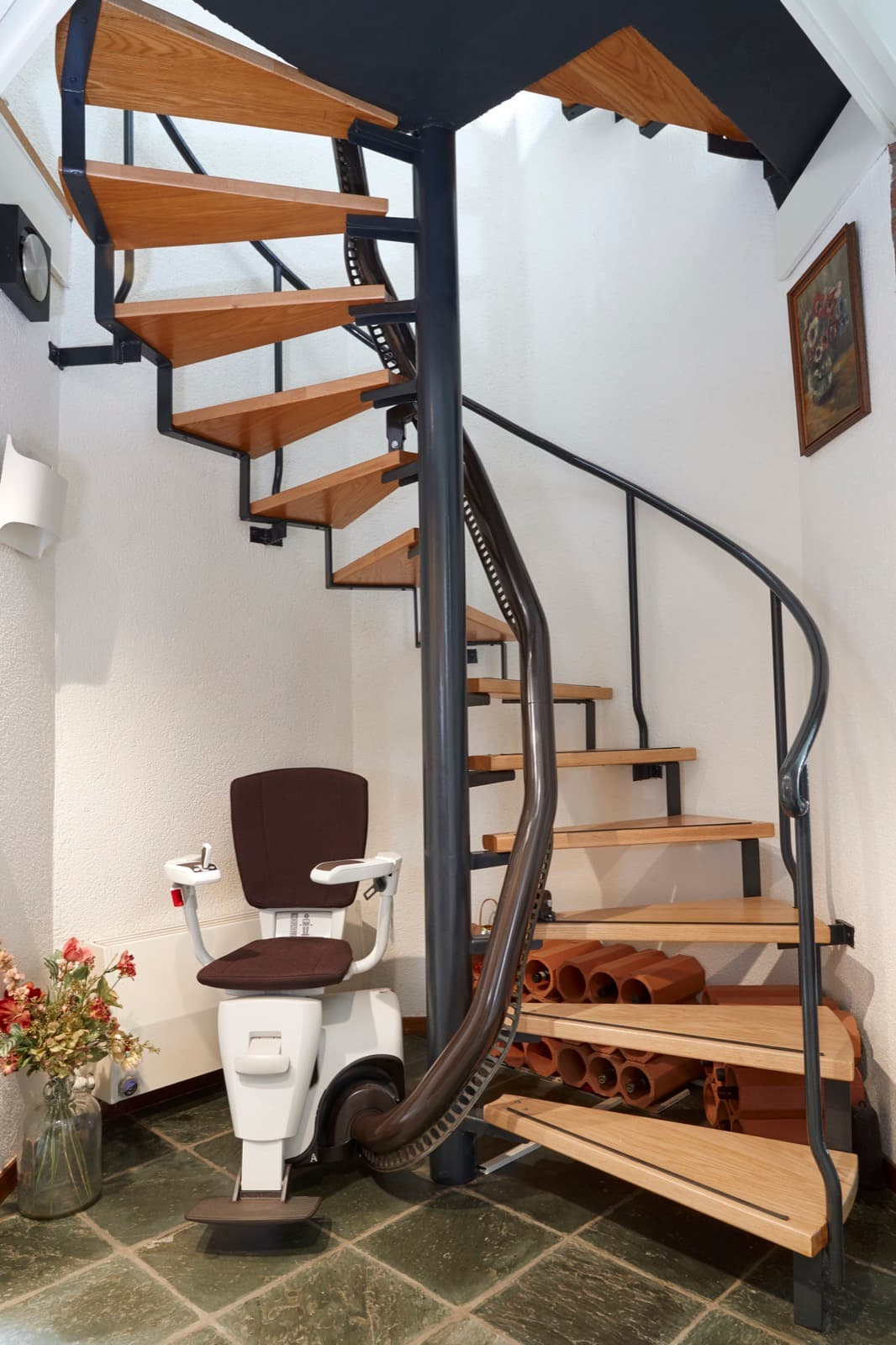
What a Spiral Staircase Stairlift Typically Costs
There is no single sticker price for a spiral staircase stairlift because each rail is custom-fabricated to one specific stairway. For context, national installed planning ranges are straight $2,500-$8,000, curved $10,000-$20,000, and outdoor $4,000-$12,000 (NCOA; Fixr).
Spiral and tightly curved staircases sit at the upper end of the curved range and above. Dealer data (clearly labeled as context, not independent) commonly put single-bend curved installs at $12,000-$20,000, with spiral and multi-turn builds going higher. One large dealer's pricing guide states curved-rail lifts start around $12,000 and range to $25,000+, depending on staircase configuration and options, and that optional features can add $750-$2,500+ (Lifeway Mobility).
Why the wide range: the rail must be precision-measured and bent for your stairs. More turns, a longer rail, tight landings, and multiple flights each add cost and lengthen the custom build. Treat any figure you see online as a starting point only; the only accurate number comes from an in-home measurement.
Can a Stairlift Even Fit Your Spiral Staircase? (Feasibility Limits)
Feasibility is the first question to settle before cost. Curved stairlifts can be built for spiral and tight-turn staircases, but not every spiral qualifies. Manufacturers note that curved stairlifts are "fabricated to fit virtually any staircase—whether your stairs are straight with landings, spiral, or angled," with each unit built one-of-a-kind for your home (Harmar).
Key limits to know:
- Center-pole spirals are challenging and sometimes a dealbreaker. Spiral staircases built around a single central column with treads that taper toward the center leave little room, and the rail must be designed to pass tight turning points without hitting the central pole or bannister. This is why a specialist model and a site assessment are essential (Stairlift Costs).
- Usable stair width matters. A curved chair lift mounts to one side and uses a folding seat so others can still pass. Manufacturer specs list a folded width measured from the wall (Harmar's Helix lists a 16-inch folded width), but very narrow or steeply pitched spirals may leave too little clearance (Harmar).
- Tight radius increases difficulty. The rail is precision-bent to match each turn using digital measurement and 3D modeling. Installers use laser or photo measurement to build a 3D model of the staircase and bend the rail to match, but very tight or irregular inner radii push the limits of what can be built (Stairlift Costs).
Because every spiral is different, a qualified installer must measure on site to confirm whether a rail can be fabricated for your exact stairway.
Why an On-Site Assessment Is Non-Negotiable
For a spiral or curved staircase, a free in-home assessment isn't a sales gimmick; it's how the rail gets engineered. The rail is custom-measured, precision-fabricated, and designed for one staircase, and manufacturers stress that each curved unit is built one-of-a-kind (Harmar).
What the assessment determines:
- Whether your stair structure (especially a center pole) can physically accept a rail.
- The exact number and tightness of turns, the total rise, and landing clearances.
- Whether usable width stays safe with the seat folded for others using the stairs.
- The final fabricated price, which can't be quoted accurately by phone.
Expect the rail to be built to order after measurement. For a comparable outdoor spiral install, one dealer notes that once the custom rail arrives, the installation itself usually takes about a day (California Mobility, outdoor spiral guide). Indoor timelines are similar in principle. Get at least two or three in-home quotes so you can compare both feasibility opinions and pricing, since estimates vary widely on complex stairs.
Ongoing Costs: Service Plans and Batteries
The purchase price isn't the whole picture. Budget for upkeep, which is the same regardless of stair shape:
- Annual service plans: about $100-$300 per year (NCOA).
- Battery replacement: roughly $200-$300 each time, typically needed every 1-3 years (NCOA). Modern lifts run on rechargeable batteries so they still work in a power outage, which is why the batteries wear and need periodic replacement.
For a custom curved/spiral lift, ask the dealer up front what the service plan covers, how parts and rail-specific components are priced, and whether labor for a custom rail is included, since specialized rails can mean specialized service.
If a Stairlift Won't Work: Alternatives to Consider
If your spiral can't accept a rail, or the custom-rail cost is out of reach, there are other ways to handle stairs. These are cost-and-planning notes, not medical recommendations.
- Vertical platform lift: works like a small open elevator and can be installed indoors or outdoors (for example, to reach a porch or deck). It generally costs more than a stairlift, with dealer pricing commonly cited from around $12,000 to $35,000+ installed, but it can carry a wheelchair, which a chair-style stairlift cannot (Lifeway Mobility platform-lift guide).
- A different (straight) route: if the home has a second, straight stairway, a straight stairlift there is far cheaper ($2,500-$8,000 nationally) than fighting a spiral.
- Residential elevator or through-floor lift: the highest-cost option, but worth pricing for multi-story access.
- Main-floor living: relocating the bedroom and a full bath to the ground floor can avoid the stairs entirely.
Funding note: Medicare generally does not cover stairlifts, because it treats them as home modifications attached to the home's structure rather than durable medical equipment (NCOA). Possible help includes some Medicare Advantage plans (limited and uncommon), state Medicaid Home and Community-Based Services (HCBS) waivers, and VA benefits for eligible veterans, such as the Home Improvements and Structural Alterations (HISA) grant (NCOA). Check current rules with each program directly before relying on coverage.
Frequently asked questions
Is a spiral staircase stairlift more expensive than a regular curved one?
Usually yes. Spiral and tight-turn staircases need a more complex custom rail, which sits at the upper end of, or above, the national curved baseline of $10,000-$20,000 (NCOA; Fixr). One large dealer's guide lists curved rails starting around $12,000 and ranging to $25,000+ with options adding $750-$2,500+ (Lifeway Mobility). Only an in-home measurement gives an accurate price.
Can every spiral staircase fit a stairlift?
No. Spiral staircases built around a single center pole are challenging and sometimes cannot accept a curved lift, and very narrow or steeply pitched spirals may not leave safe clearance. A qualified installer must assess your stairway on site, using digital measurement, to confirm whether a custom rail can be fabricated (Harmar; Stairlift Costs). If it can't, a vertical platform lift, a different straight stairway, or main-floor living are alternatives.
Will Medicare or insurance pay for a spiral staircase stairlift?
Medicare generally does not, because it treats stairlifts as home modifications attached to the home's structure rather than durable medical equipment (NCOA). Some Medicare Advantage plans (limited and uncommon), state Medicaid HCBS waivers, and VA benefits for eligible veterans, such as the HISA grant, may help. Verify current eligibility and coverage directly with each program before counting on it.
Want to estimate your range in under a minute? Try the free stairlift cost calculator.
Sources
- NCOA - How Much Do Stair Lifts Cost? (installed baselines, service plans, batteries):
https://www.ncoa.org/article/stair-lift-costs-a-complete-guide/ - NCOA - Does Medicare Cover Stair Lifts? Costs, Coverage & Financial Help:
https://www.ncoa.org/article/medicare-and-stair-lifts/ - Fixr - Stairlift Installation Cost (straight, curved, and outdoor installed ranges):
https://www.fixr.com/costs/stairlift-installation - Harmar - Helix Curved Stairlifts (custom curved/spiral fabrication, folded-width spec):
https://www.harmar.com/products/helix-curved-stairlifts/ - Lifeway Mobility - Stair Lift Pricing Guide (curved-rail starting price and range, options add-on):
https://www.lifewaymobility.com/resources/product-guides/how-much-does-a-stair-lift-cost/ - Lifeway Mobility - How Much Does a Platform Lift Cost? (vertical platform lift pricing):
https://www.lifewaymobility.com/resources/product-guides/how-much-does-a-platform-lift-cost/ - Stairlift Costs - Stairlifts for Spiral or Winder Staircases (center-pole limits, tight radius, custom rail, context):
https://stairliftcosts.co.uk/narrow-stairs-stairlifts/spiral-or-winder-narrow-stairlift/ - California Mobility - Outdoor Spiral Stair Lift Installation Guide (outdoor context: every spiral is different, ~one-day install):
https://californiamobility.com/outdoor-spiral-stair-lift-installation-guide/